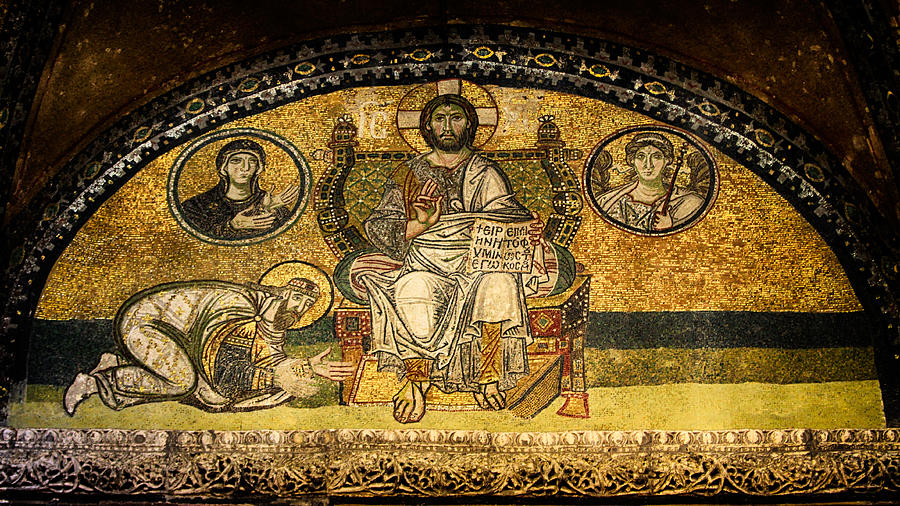
Imperial Door Mosaic
A Testament to Divine Authority and Imperial Penance
The Emperor Before Christ
The Imperial Door Mosaic stands as one of the most significant and emotionally powerful works of Byzantine art. Located above the Imperial Door in the narthex of Hagia Sophia, this 9th-century masterpiece depicts Emperor Leo VI (886-912 AD) in an unprecedented act of humility—prostrating himself before Christ Pantocrator.
This mosaic is not merely decorative art; it is a profound theological and political statement, representing the complex relationship between imperial power and divine authority in Byzantine civilization. The image of the most powerful ruler in the Christian world bowing before Christ served as a reminder to all who entered that earthly power is subordinate to heavenly authority.
Artistic Composition
Understanding the Visual Elements
Christ Pantocrator
At the center sits Christ Pantocrator ('Ruler of All') on a jeweled throne, dressed in royal blue and gold. His right hand is raised in blessing while his left holds an open Gospel book inscribed with 'Peace be with you. I am the light of the world' (John 8:12, 20:19).
Emperor Leo VI
The emperor is depicted in proskynesis—full prostration—at Christ's feet. He wears imperial regalia but assumes a position of complete submission, his crown nearly touching the ground. This unprecedented depiction of an emperor shows the supremacy of divine over earthly authority.
The Virgin Mary
In a medallion to Christ's left (viewer's right), the Virgin Mary appears in traditional blue maphorion, her hands raised in prayer. She intercedes on behalf of the emperor and all humanity.
Archangel Gabriel
Balancing the composition, Archangel Gabriel appears in the medallion to Christ's right. As the messenger of God, Gabriel represents divine communication and the bridge between heaven and earth.
Detailed view of Christ Pantocrator and Emperor Leo VI in proskynesis
Historical Context
The Story Behind the Mosaic
The creation of this mosaic is inextricably linked to one of the most controversial episodes in Byzantine history—Emperor Leo VI's fourth marriage. Byzantine Church law strictly forbade fourth marriages, yet Leo VI, desperate for a male heir, married his mistress Zoe Karbonopsina in 906 AD after she bore him a son (the future Constantine VII).
This act resulted in Leo's excommunication by Patriarch Nicholas I Mystikos and caused a major scandal known as the Tetragamy ('Four Marriages') controversy. The mosaic is believed to have been commissioned as an act of public penance, demonstrating the emperor's submission to divine authority despite his temporal power.
The positioning above the Imperial Door—the entrance used exclusively by the emperor—meant that Leo VI himself would pass beneath this image of his own prostration every time he entered the church, a constant reminder of his submission to God.
Leo VI becomes Byzantine Emperor
Leo VI's controversial fourth marriage
Emperor excommunicated by Patriarch
Imperial Door Mosaic likely commissioned
Death of Leo VI
Symbolism & Meaning
Decoding the Byzantine Visual Language
Gold Background
The brilliant gold tesserae represent divine light and the heavenly realm. Gold in Byzantine art signifies the eternal, unchanging nature of God.
The Throne
Christ's jeweled throne represents both the Throne of Solomon and the Throne of Judgment, emphasizing Christ's roles as King and Judge.
Prostration Pose
The proskynesis position was the highest form of reverence in Byzantine court ceremony. Its use here shows the emperor acknowledging a power greater than his own.
Open Book
The Gospel book inscribed with words of peace suggests that submission to divine authority brings salvation and harmony.
Circular Medallions
The roundels containing Mary and Gabriel create a heavenly hierarchy, with Christ at the apex and holy intercessors surrounding him.
Mosaic Technique
Byzantine Craftsmanship
The Imperial Door Mosaic exemplifies the highest achievements of Byzantine mosaic art. Created using the opus tessellatum technique, it employs thousands of tiny tesserae (small cubes) made from glass, gold leaf, and natural stone.
The gold background is created using glass tesserae backed with gold leaf, set at slightly varying angles to catch and reflect light from different directions. This technique, known as 'setting at angle,' creates the characteristic shimmering effect of Byzantine mosaics.
The faces and hands are rendered with exceptional delicacy, using smaller tesserae and subtle gradations of color to achieve naturalistic flesh tones. The drapery folds are depicted with bold, confident lines that demonstrate the master mosaicists' complete command of their medium.
Materials Used
Gold Tesserae
Glass backed with gold leaf for divine radiance
Blue Glass
For Christ's robes, symbolizing heaven
Red Glass
For imperial garments and accents
White Marble
For flesh tones and highlights
Black Stone
For outlines and details
Frequently Asked Questions
Visiting the Mosaic
Plan Your Experience
- Located above the Imperial Door in the inner narthex
- Best viewed in morning light when sunlight illuminates the gold tesserae
- Bring binoculars for a closer view of the intricate details
- Photography is permitted but without flash
- Check prayer times as the mosque closes during prayers
Related Mosaics
Explore More Byzantine Art