When Was Hagia Sophia Built? The Complete History
Hagia Sophia stands as a monumental testament to human ingenuity, resilience, and faith, captivating millions with its awe-inspiring architecture and rich history. This article delves into the intricate timeline of its construction, exploring not just the "when" but also the "why" and "how" behind its various incarnations. From its origins as a modest wooden basilica to its current status, we uncover the fascinating journey of this iconic stru...
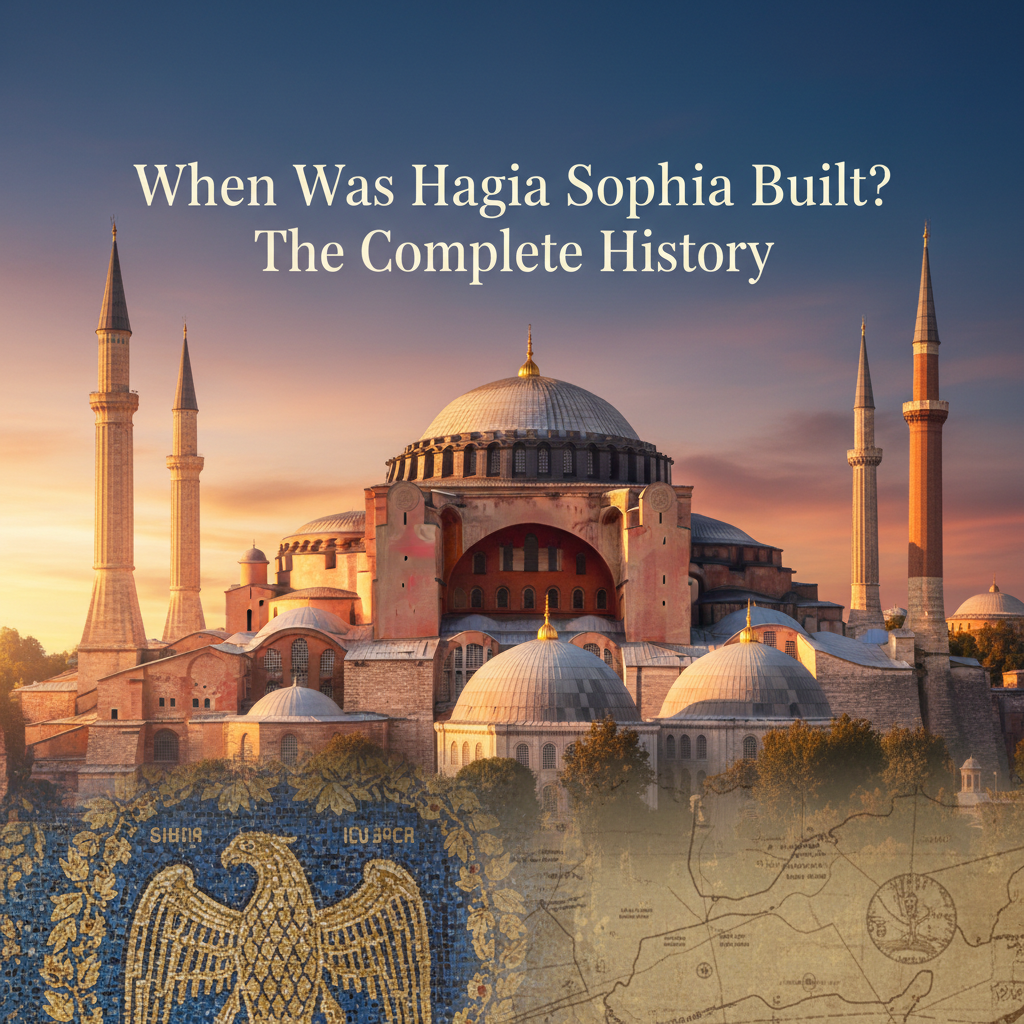
When Was Hagia Sophia Built? The Complete History
Hagia Sophia stands as a monumental testament to human ingenuity, resilience, and faith, captivating millions with its awe-inspiring architecture and rich history. This article delves into the intricate timeline of its construction, exploring not just the "when" but also the "why" and "how" behind its various incarnations. From its origins as a modest wooden basilica to its current status, we uncover the fascinating journey of this iconic structure, providing tourists and history enthusiasts with a comprehensive guide to understanding its profound significance. Prepare to journey through centuries of empires, religious transformations, and architectural marvels that define Hagia Sophia. Hagia Sophia: History & Architecture
The First Incarnation: The Great Church (360 AD)
The story of Hagia Sophia begins long before the grand dome we know today graced the Istanbul skyline. Its origins trace back to the early 4th century, a period of significant change for the Roman Empire. Emperor Constantine I had recently established Constantinople as the new capital, and with it came a surge in Christian influence.
Emperor Constantius II and the First Basilica
It was under the reign of Emperor Constantius II, son of Constantine I, that the first church on this site was consecrated. This initial structure, often referred to as the "Great Church" or "Magna Ecclesia," was a traditional basilica. Built predominantly of wood, it served as the principal cathedral of the new imperial city.
This early basilica was a significant symbol of the burgeoning Christian faith within the Roman Empire. Its construction in 360 AD marked a pivotal moment, laying the foundation for what would become one of the world's most enduring architectural wonders. While modest by later standards, it held immense spiritual and political importance for the nascent Christian community in Constantinople.
The Second Incarnation: The Theodosian Basilica (415 AD)
The Great Church, despite its significance, was not destined to last. Political and religious tensions often ran high in the imperial capital, leading to its unfortunate destruction. However, the site's importance meant that reconstruction was inevitable.
Destruction During Riots
In 404 AD, riots erupted in Constantinople following the exile of Patriarch John Chrysostom. These civil disturbances, fueled by political machinations and popular discontent, led to the burning and destruction of the first Hagia Sophia. The city mourned the loss of its grand cathedral, but its spirit remained unbroken.
Emperor Theodosius II's Vision
A little over a decade later, Emperor Theodosius II commissioned the construction of a new basilica on the same hallowed ground. This second church, completed in 415 AD, was also a grand, timber-roofed basilica. Its design was more elaborate than its predecessor, featuring monumental entrances and rich interior decorations. Archaeological excavations have revealed impressive marble blocks and architectural fragments from this period, offering glimpses into its former glory.
The Theodosian Basilica served the city for over a century, witnessing numerous imperial ceremonies and religious rites. It stood as a testament to the enduring power of Christianity and the resilience of the Byzantine Empire. However, like its forerunner, it too would fall victim to the volatile atmosphere of Constantinople.
The Third Incarnation: Justinian's Masterpiece (537 AD)
The most famous and enduring iteration of Hagia Sophia, the one largely visible today, came into being under the visionary leadership of Emperor Justinian I. This period marks the true zenith of Byzantine architectural achievement.
The Nika Riots and Total Destruction (532 AD)
The catalyst for the third, and final, reconstruction was the devastating Nika Riots of 532 AD. These riots, sparked by political grievances and factional rivalries, engulfed Constantinople in chaos. Much of the city, including the Theodosian Basilica, was razed to the ground. Justinian, initially considering fleeing, was persuaded by his wife Empress Theodora to stay and quell the rebellion. After successfully suppressing the riots, he embarked on an ambitious rebuilding program.
Emperor Justinian I's Grand Vision
Determined to construct a church unlike any other, a building that would symbolize the glory of his empire and the might of God, Justinian chose two brilliant geometers and architects: Anthemius of Tralles and Isidore of Miletus. Their task was immense: to create a structure that would surpass all previous architectural feats. Justinian reportedly declared, "Solomon, I have surpassed thee!" upon its completion, reflecting his immense pride.
Construction Begins (532 AD)
Construction began almost immediately after the Nika Riots were quelled in 532 AD. Justinian spared no expense, gathering materials from across the empire. Columns of porphyry were brought from Rome, green marble from Thessaly, white marble from Marmara, and yellow marble from Africa. Thousands of workmen were employed, working tirelessly day and night. The speed of construction was unprecedented for such a monumental undertaking.
Completion and Consecration (537 AD)
Astonishingly, the new Hagia Sophia was completed in just under six years, a remarkable feat of engineering and organization for the 6th century. It was consecrated on December 27, 537 AD, in a grand ceremony presided over by Emperor Justinian himself. The building immediately became the largest cathedral in the world, holding that title for nearly a thousand years until the completion of Seville Cathedral.
Architectural Marvels of Justinian's Hagia Sophia
The design of Justinian's Hagia Sophia was revolutionary, blending elements of a longitudinal basilica with a centralized plan, all crowned by its massive, iconic dome.
The Dome: A Celestial Canopy
The most striking feature is undoubtedly its colossal dome, which appears to float above the nave. This effect is achieved through an innovative system of pendentives, spherical triangular segments that transition the square base of the building to the circular base of the dome. The dome itself has a diameter of approximately 31 meters (102 feet) and rises 55 meters (180 feet) from the floor. Its original design was even more daring, and it collapsed in 558 AD due to an earthquake, only to be rebuilt by Isidore the Younger, a nephew of one of the original architects, with a slightly higher and more stable profile.
Materials and Techniques
The construction utilized techniques advanced for its time, including the use of lightweight bricks for the dome and a special mortar that was stronger than the bricks themselves. The interior was adorned with exquisite marbles, mosaics, and precious metals, creating an ethereal atmosphere. The light pouring in from the forty windows at the base of the dome was designed to illuminate the vast space, giving the impression of divine light.
Interior Decorations and Mosaics
Originally, the interior was adorned with abstract patterns and crosses. Later, during the Byzantine era, magnificent figural mosaics depicting Christ, the Virgin Mary, saints, and emperors were added. These mosaics, some of which are still visible today, represent the pinnacle of Byzantine art. They offer invaluable insights into the religious and imperial iconography of the period.
Transformations Through the Centuries
Hagia Sophia's history did not end with its construction. It continued to evolve, reflecting the changing fortunes and rulers of Constantinople.
The Latin Occupation (1204-1261)
During the Fourth Crusade, Constantinople was sacked by Latin Crusaders in 1204. Hagia Sophia was plundered, its precious relics stolen, and its sacred spaces desecrated. For 57 years, it served as a Roman Catholic cathedral, a period marked by neglect and further damage to its artistic treasures.
Ottoman Conquest and Conversion to Mosque (1453)
The most significant transformation occurred with the Ottoman conquest of Constantinople in 1453. Sultan Mehmed II, after capturing the city, immediately ordered Hagia Sophia to be converted into a mosque. This conversion involved several architectural alterations. The most noticeable additions were the four minarets, which were added over time by various sultans, and the removal of the great bell.
Inside, the Christian mosaics were plastered over or covered with calligraphic roundels bearing the names of Allah, Prophet Muhammad, the first four Caliphs, and Hasan and Husayn. A mihrab (prayer niche) was installed in the apse, facing Mecca, and a minbar (pulpit) was added. Despite these changes, the fundamental structure of Justinian's masterpiece remained intact, allowing it to continue serving as a place of worship for nearly five centuries.
A Museum (1935)
In 1935, under the secular reforms of Mustafa Kemal Atatürk, Hagia Sophia was desacralized and transformed into a museum. This decision allowed for the uncovering and restoration of many of its magnificent Byzantine mosaics, making them accessible to the public once again. As a museum, Hagia Sophia became a symbol of cultural heritage, bridging East and West, Christianity and Islam.
Back to a Mosque (2020)
In July 2020, Hagia Sophia was reclassified as a mosque by the Turkish government. This decision sparked international debate and mixed reactions. While it continues to function as a mosque, efforts are made to preserve its historical and artistic elements, with curtains or retractable screens used to cover Christian imagery during prayer times.
Conclusion: A Living Monument
Hagia Sophia is more than just an ancient building; it is a living monument that encapsulates millennia of human history, religious devotion, and architectural innovation. From its humble beginnings in 360 AD to its grand reconstruction under Justinian in 537 AD, and through its subsequent transformations, it has stood as a silent witness to empires rising and falling, cultures clashing and merging.
For tourists and history enthusiasts, understanding "when was Hagia Sophia built" is merely the starting point. The true depth of its story lies in appreciating its continuous evolution, its resilience against destruction, and its profound spiritual significance across different faiths. Its walls whisper tales of Byzantine emperors, Ottoman sultans, and countless worshippers who have found solace and inspiration within its hallowed halls. Whether viewed as an architectural marvel, a historical document, or a sacred space, Hagia Sophia continues to inspire awe and wonder, inviting all who visit to ponder the enduring power of human endeavor and belief.